Why the Current Map Algorithm Prioritizes Specific Street-View Photos
The landscape of local search has undergone a seismic shift as we move into 2026. For years, the foundation of google business profile seo was built on text: the right keywords, the correct NAP (Name, Address, Phone number) consistency, and a healthy volume of reviews. But today, text is merely the baseline. We have entered the era of the “Visual Shift,” where Google’s algorithm no longer takes your word for it – it verifies your existence through high-fidelity imagery. If you want to Why your blurry shop photos are costing you the Google 3-Pack, you must understand that visual verification is the new gold standard for local authority.
In this high-stakes environment, Google utilizes what I call “Visual Confidence Scores.” This isn’t a metric you’ll find in your standard dashboard, but it is the invisible hand driving the local map pack. Google’s computer vision AI now scans Street View data, user-contributed 360-degree photos, and storefront images to confirm that a business is exactly where it says it is and offers exactly what it claims. This shift toward visual evidence is designed to combat spam and provide users with a “what you see is what you get” experience before they even leave their house.
The Science of “Visual Confidence”: How Google Sees Your Storefront
To understand why specific photos trigger a ranking boost, we have to look under the hood at Google’s computer vision capabilities. Google doesn’t just “look” at a photo like a human does; it deconstructs it into a three-dimensional mathematical model. Central to this process is the “piecewise planar global model,” a sophisticated technical framework used to reconstruct building facades from optical-flow data. By analyzing multiple angles of a street, the algorithm can determine the depth, height, and exact coordinates of your storefront with terrifying precision.
This isn’t just theoretical AI – it’s backed by years of legal and technical groundwork. Specifically, Google Patent US8312010B1 regarding “Local business ranking using mapping information” outlines how the proximity and visual prominence of a business within mapping data directly influence its rank. When Google’s AI identifies “Visual Proof of Life” – such as clear signage, a well-defined entrance, and consistent neighborhood context – it assigns a higher confidence score to that entity. If your storefront is obscured, outdated, or visually inconsistent with your digital claims, your ranking will suffer. To stay ahead, savvy marketers are using google maps seo tools to analyze how their visual presence stacks up against the competition.
The algorithm is essentially performing a real-time audit. It asks: Does the signage text match the Google Business Profile title? Is the entrance clear and unobstructed? Does the architecture match the category of business? A “high confidence” result leads to a dominant position in the Map Pack, while “low confidence” results are pushed to the second or third page, regardless of how many keywords are stuffed into the description.
Why “Official” Street View Data is Often Stale (And How to Fix It)
One of the biggest hurdles in local SEO is the “Data Gap.” The official Google Street View car is a marvel of technology, but it isn’t everywhere at once. In many suburban or rapidly developing urban areas, the “official” imagery might be two or three years old. If you’ve renovated your storefront, changed your signage, or moved into a new development, that stale data is actively working against your google business profile seo.
This is where the power of manual intervention comes in. Industry leaders and high-level contributors have shown the way forward. For instance, look at the work of Brett Mommsen, who famously captured over 3000KM of fresh Street View data using the Insta360Pro2. This level of granular, high-resolution data collection proves that the algorithm rewards freshness and detail. When you provide fresh, high-resolution 360-degree imagery, you are essentially “forcing” the algorithm to update its understanding of your location.
By using Street View Studio to upload your own imagery, you can improve local search presence by bridging the gap between what the Google car saw in 2023 and what your business looks like today. This is a proactive strategy to Map Listing Optimization: How to Rank for 2026 Visual Intent. You are no longer a passive observer of your map presence; you are the primary data provider for Google’s visual engine.
Visual Cues That Trigger the 2026 Ranking Boost
Not all photos are created equal. In 2026, the algorithm is specifically tuned to identify and reward three core visual elements. If your imagery lacks these, you are leaving ranking power on the table. To maximize your results, consider a comprehensive google business profile optimization strategy that prioritizes these triggers:
- Signage Recognition: Google’s OCR (Optical Character Recognition) is now advanced enough to read signs from extreme angles. It compares the text on your physical building to your GBP name. A perfect match increases your “Entity Authority.” If your sign says “Joe’s Pizza” but your profile says “Joe’s Best New York Style Pizza in Brooklyn,” the discrepancy can actually trigger a ranking dampener.
- Accessibility Signals: Google is heavily prioritizing “Attributes” in 2026. The AI looks for ramps, wide entrances, and flat entryways. If the Street View AI “sees” a wheelchair-accessible entrance, it will automatically validate that attribute on your profile, boosting your visibility for users searching for accessible locations.
- Category Verification: The algorithm performs a visual “sanity check” on your business category. If you are listed as a “Restaurant,” the AI expects to see outdoor seating, menus in the window, or a clear dining area. If you are a “Plumber” but your Street View shows a residential house with no branded van, Google may lower your ranking for high-intent commercial searches because the visual evidence doesn’t support the business type.
To ensure these cues are being captured correctly, you may want to look into The One Tweak to Service Menus That Actually Expands Your Map Reach, as visual menus are now being cross-referenced with Street View window displays.
The “Proximity Trap” and Visual Geo-Location
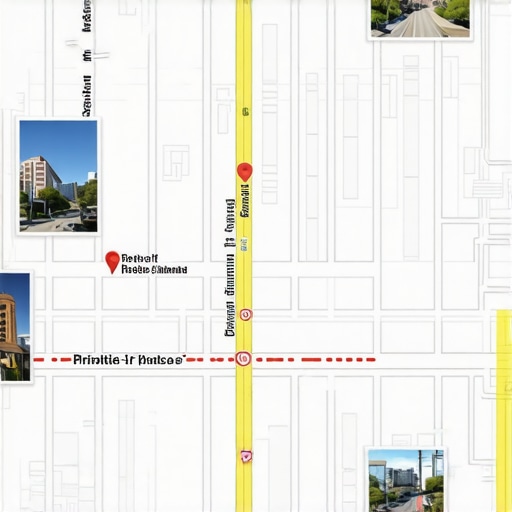
One of the most frustrating issues for local businesses is “Pin Drift” – when Google’s map pin is slightly off, leading customers to a back alley or a neighboring parking lot. In 2026, this isn’t just a navigation issue; it’s a ranking issue. Google uses visual geo-location to solve this. By cross-referencing your uploaded photos with the surrounding “fabric” of the street, the algorithm verifies your exact coordinates.
The technical backbone of this is the Street View Insights API. This API classifies visual content to extract actionable intelligence. It looks at landmarks, neighboring storefronts, and street furniture (like lamp posts and fire hydrants) to triangulate your position. If your visual data is clear, Google can confidently rank google business profile higher because it knows exactly where to send the user. If you are struggling with accuracy, you need to learn How to fix the map pin drift that sends customers to the wrong parking lot immediately.
The “Proximity Trap” occurs when a business is physically close to a searcher but lacks the visual data to prove its entrance is accessible. By providing a clear “Entrance” photo in your Street View contributions, you tell the algorithm exactly where the “human-to-business” interaction happens, which is a major signal for the 2026 proximity-based algorithm.
5 Actionable Steps to Optimize Your Street View Presence
If you want to dominate the local map pack, you cannot rely on luck. You need a systematic approach to visual optimization. Follow this checklist to ensure you are feeding the algorithm the data it craves. You can also use a google maps ranking service to automate much of this process.
- Deploy User-Generated 360s: Don’t wait for the Google car. Hire a Google Trusted Photographer or purchase a 360 camera (like the Insta360 series) to capture high-resolution panoramas of your exterior and interior. Upload these directly via the Street View app or Studio.
- Prioritize the “Entrance” Photo: The algorithm needs to see the door. Ensure your primary exterior photo is taken from the perspective of a pedestrian standing on the sidewalk. This helps the AI understand the flow of traffic to your business.
- Capture Neighborhood Context: When taking 360 photos, don’t just focus on your door. Capture the shops to your left and right. This helps Google’s piecewise planar global model stitch your business into the local map more accurately.
- Audit and Remove Visual Noise: Check your current Street View. Is there a giant delivery truck blocking your sign? Is there “ghosting” from a bad stitch? If so, you need to overwrite that data with new, clean uploads to clear up any AI confusion.
- Use Professional Audit Tools: Regularly use local seo ranking tools to see how your visual presence correlates with your ranking fluctuations. Often, a dip in rank coincides with a change in how Google is rendering your street-level data.
For more detailed technical fixes, refer to our guide on 4 Map Listing Optimization Fixes for 2026 Visual Search [Data]. These steps are not optional in a world where Google’s AI is the primary gatekeeper of local traffic.
Conclusion: Dominating the Visual Map Pack
The transition to a visual-first algorithm is the most significant change to local SEO in a decade. We are moving away from a world of “claims” and into a world of “verification.” In 2026, if Google’s AI cannot visually confirm your signage, your entrance, and your category through Street View and high-fidelity imagery, your google business profile seo efforts will hit a hard ceiling.
The algorithm is no longer just a search engine; it is a digital twin of the physical world. By understanding the mechanics of the piecewise planar global model and leveraging the power of 360-degree data, you can give Google the “Visual Confidence” it needs to put you at the top of the Map Pack. Stop thinking of photos as “decorations” for your profile and start seeing them as the technical data points they are.
It is time to audit your profile’s visual health. If your Street View is blurry, outdated, or non-existent, you are invisible to the algorithm. Take control of your visual narrative today by using SEO Viper Tools to analyze, optimize, and dominate your local market. The future of search is visual – make sure you’re seen.